Showing posts with label Films & Documentaries. Show all posts

Friday, 18 March 2022

Oliver Stone’s 2016 Ukraine on Fire defies mainstream narrative on Russia-Ukraine war

 Article published in Travel Tomorrow


Ukraine on Fire presents a likely controversial overview of Ukraine’s political history leading up to the 2014 protests in Euromaidan and shedding light on today’s military developments in Eastern Europe.


Directed by Igor Lopatonok and produced by Oscar winner Oliver Stone, the 2016 documentary defies the mainstream media narrative on the geopolitical analysis of the Russia-Ukraine conflict, spanning events from the World War II to the Cold War. The film features the international pressure over Ukraine — leading to an apparent coup d’état ousting the democratically elected Viktor Yanukovich and culminates with the implications of NATO expansion.

In the documentary, Oliver Stone uses his critical lens on the Ukraine crisis, and more specifically on the role played by the US. Labelled as propaganda by the Western media, Russia’s argument of “denazifying” Ukraine as a justification for the invasion is analysed in Ukraine on Fire with the spotlight on a number of neo-nazis groups that, over time, seemed to have incorporated the Ukrainian National Guard.


Ukrainian Nazis joining forces with Hitler


In a throwback to World War II, the documentary denounces the estimated 80,000 Ukrainian ultra-nationalists — notorious for their cruelty towards the Polish, the Jewish and Russian people — who have joined the Schutzstaffel, the infamous Nazi SS.

In 1929, the Organization of Ukrainian Nationalists (OUN) was founded by Stefan Bandera, an ardent nationalist known by the CIA for leading a “reign of terror” and masterminding several ethnic cleansing operations, such as the 1941 Babi Yar massacre, where nearly 34,000 Jews were killed. However, after the war, Bandera fled to Europe, backed by the CIA for safe entry.


Cold War


“The CIA’s fingerprints can be found throughout the conflict,” the film stated, referring to the aftermath of the protests in Ukraine, both the 2004 and 2014 revolutions and events dating back to the Cold War. According to the documentary, CIA documents declassified in 2016 reveal strong ties between US intelligence and Ukrainian nationalists since 1946.

Such ties would serve as a possible source of counter-intelligence against the Soviet Union. During the Cold War, Ukrainian nationalists were part of numerous military operations, including Operation Belladona, Operation Lynx, and Operation Trident. Yet, during the Nuremberg trials in 1945-1956, Ukrainian Nazis were spared from proper justice. “By 1951, the Agency [CIA] excused the illegal activities of OUN’s security branch in the name of Cold War necessity,” reads a declassified memo from the CIA.

The Ukrainian ultra-nationalist movement kept growing with names like Dmytro Dontsov, Andriy Melnyk and Roman Shukhevych shaping the neo-Nazi movement. In 1989, the Ukrainian nationalist organisation Narodny Rukh (People’s Movement) was created, serving as an incubator for neo-Nazi leaders against the Soviet Union’s trajectory towards the West guided by Mikhail Gorbachev’s Perestroika and Glasnost policies.

Shortly before the end of the Soviet Union, in 1991, Oleh Tyahnybok founded yet another nationalist group, Svoboda, which ideology was the purging of Jews and ethnic Russians in Ukraine. As early as 2012, the BBC reported the danger of Ukraine’s ultra-nationalists, particularly Svoboda, and the EU passed a resolution condemning the group as anti-Semitic and xenophobic.


US ties with Svoboda


Despite the warnings from Europe, Victoria Nuland from the US State Department met Tyahnybok, Svoboda’s leader, in February 2014, ahead of the Euromaidan protests. The plot thickens when Nuland was caught on tape with the US Ambassador to Ukraine, Geoffrey Pyatt, masterminding an apparent coup d’état. “Now it would be great to help glue this thing and have the UN help glue it and, you know, f*ck the EU,” said Nuland.

Recalling his troubled tenure as a President (2010-2014), Viktor Yanukovich told Oliver Stone: “My high-level contact was VP Joe Biden. We had frequent phone conversations but the problem was that Mr Biden said one thing but they did different things in Ukraine.”

As for Mr Pyatt, the US Ambassador, Yanukovich said he received visits from Maidan representatives all the time. “We got the impression that the headquarters in charge of the whole process was in the US embassy,” said Yanukovich.


EU and IMF pressure


Throwing back to 2013, Yanukovich explained that Ukraine was going through a difficult economic period and the country was torn between turning to the EU, the International Monetary Fund (IMF), or Russia. With an existing trade agreement with Russia, Yanukovich sought to negotiate a new — and better — agreement, but both the EU and the IMF offered “unacceptable solutions”, he said.

“A significant rise in utility rates, for electricity and natural gas. This would mean a lot more expenses for the people, while their income would stay at the same level,” said Yanukovich about the IMF’s proposal. Ukraine suggested other solutions, but these were officially rejected by the IMF in November 2013.

Kyiv was left with Russia, which said it was ready for partnership if their interests were taken into account. Interviewed by Oliver Stone, the Russian President Vladimir Putin said that an agreement with Ukraine “would mean that EU goods would enter the Russian market without any negotiations”, which was not tolerated by the EU.

Talking about the trade agreement proposed by the EU, Yanukovich said that Ukraine couldn’t go ahead because it “required essential economic expenses and Europe didn’t provide any loss balancing.”

Euromaidan


After Ukraine’s decision to move towards the East for trade partnerships, the documentary reveals the manufacturing of a protest, with Euromaidan right behind the corner. As the November 2013 protest started in Ukraine, three new TV channels went on the air and suddenly became stunningly popular. Spilno TV was launched on November 21, Hromadske TV went live on November 22 and Expresso TV followed on November 24. These channels went viral supporting the protests, which were asking for an alignment with the EU and encouraging more and more people to go to Maidan.

Eventually, the protests led to overthrowing the President Yanukovich after an apparent coordinated action between the US and Ukrainian nationalist groups. Such outcome was reported by the filmmaker as the result of a successful staged revolution which included “money, the media and techniques”.

NATO expansion


A crucial element featured in the documentary is NATO’s military threat bordering the Russian Federation. NATO has not stopped expanding since the fall of the Soviet Union, growing from 17 countries in 1990 to 30 today, several of which were once part of the Soviet-led Warsaw pact.

“Why do we react so vehemently to NATO’s expansion?” asked Putin. “We are concerned with the decision-making process. I know how decisions are made. As soon as the country becomes a member of NATO, it can’t resist the pressure of the USA.”

Putin stressed the military threat that NATO membership poses to Russia, saying that “anything at all can appear in such country such as missile defense systems, new bases, or, if necessary, new missile strike systems.”

Putin’s lack of sense of security has been compared to the Cuban missile crisis in 1962, when the US drew a red line in respect of the installation of medium-range missiles 70 km from its border and the world was at the brink of nuclear war.

“This is a very dangerous topic. It’s a topic of war. War between the US and Russia would be complete madness,” said Yanukovich referring to NATO expansion.

Described by critics as Russian propaganda, Oliver Stone’s Ukraine on Fire 2016 documentary presents verifiable claims that bring a different perspective when reflecting on the military escalation in Ukraine and have recently been voiced by the US political scientist John Mearsheimer.

Sunday, 19 April 2020

Shoshana Zuboff on surveillance capitalism | VPRO Documentary


'“Surveillance capitalism,” Zuboff writes, “unilaterally claims human experience as free raw material for translation into behavioural data. Although some of these data are applied to service improvement, the rest are declared as a proprietary behavioural surplus, fed into advanced manufacturing processes known as ‘machine intelligence’, and fabricated into prediction products that anticipate what you will do now, soon, and later. Finally, these prediction products are traded in a new kind of marketplace that I call behavioural futures markets. Surveillance capitalists have grown immensely wealthy from these trading operations, for many companies are willing to lay bets on our future behaviour.”

While the general modus operandi of Google, Facebook et al has been known and understood (at least by some people) for a while, what has been missing – and what Zuboff provides – is the insight and scholarship to situate them in a wider context. She points out that while most of us think that we are dealing merely with algorithmic inscrutability, in fact what confronts us is the latest phase in capitalism’s long evolution – from the making of products, to mass production, to managerial capitalism, to services, to financial capitalism, and now to the exploitation of behavioural predictions covertly derived from the surveillance of users. In that sense, her vast (660-page) book is a continuation of a tradition that includes Adam Smith, Max Weber, Karl Polanyi and – dare I say it – Karl Marx.

Viewed from this perspective, the behaviour of the digital giants looks rather different from the roseate hallucinations of Wired magazine. What one sees instead is a colonising ruthlessness of which John D Rockefeller would have been proud. First of all there was the arrogant appropriation of users’ behavioural data – viewed as a free resource, there for the taking. Then the use of patented methods to extract or infer data even when users had explicitly denied permission, followed by the use of technologies that were opaque by design and fostered user ignorance.


And, of course, there is also the fact that the entire project was conducted in what was effectively lawless – or at any rate law-free – territory. Thus Google decided that it would digitise and store every book ever printed, regardless of copyright issues. Or that it would photograph every street and house on the planet without asking anyone’s permission. Facebook launched its infamous “beacons”, which reported a user’s online activities and published them to others’ news feeds without the knowledge of the user. And so on, in accordance with the disrupter’s mantra that “it is easier to ask for forgiveness than for permission”.'


Friday, 10 April 2020

Documentary: The Crisis of Science (The Corbett Report)


In 2015 a study from the Institute of Diet and Health with some surprising results launched a slew of click bait articles with explosive headlines: “Chocolate accelerates weight loss” insisted one such headline.

“Scientists say eating chocolate can help you lose weight” declared another.

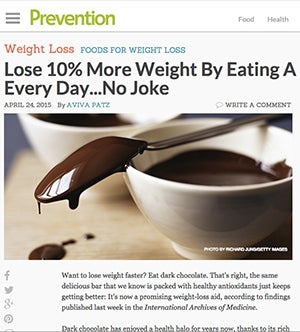
“Lose 10% More Weight By Eating A Chocolate Bar Every Day…No Joke!” promised yet another.

There was just one problem: This was a joke.

The head researcher of the study, “Johannes Bohannon,” took to io9 in May of that year to reveal that his name was actually John Bohannon, the “Institute of Diet and Health” was in fact nothing more than a website, and the study showing the magical weight loss effects of chocolate consumption was bogus. The hoax was the brainchild of a German television reporter who wanted to “demonstrate just how easy it is to turn bad science into the big headlines behind diet fads.”

Given how widely the study’s surprising conclusion was publicized—from the pages of Bild, Europe’s largest daily newspaper to the TV sets of viewers in Texas and Australia—that demonstration was remarkably successful. But although it’s tempting to write this story off as a demonstration about gullible journalists and the scientific illiteracy of the press, the hoax serves as a window into a much larger, much more troubling story.

That story is The Crisis of Science. This is The Corbett Report.

What makes the chocolate weight loss study so revealing isn’t that it was completely fake; it’s that in an important sense it wasn’t fake. Bohannes really did conduct a weight loss study and the data really does support the conclusion that subjects who ate chocolate on a low-carb diet lose weight faster than those on a non-chocolate diet. In fact, the chocolate dieters even had better cholesterol readings. The trick was all in how the data was interpreted and reported.

As Bohannes explained in his post-hoax confession:

“Here’s a dirty little science secret: If you measure a large number of things about a small number of people, you are almost guaranteed to get a ‘statistically significant’ result. Our study included 18 different measurements—weight, cholesterol, sodium, blood protein levels, sleep quality, well-being, etc.—from 15 people. (One subject was dropped.) That study design is a recipe for false positives.”

You see, finding a “statistically significant result” sounds impressive and helps scientists to get their paper published in high-impact journals, but “statistical significance” is in fact easy to fake. If, like Bohannes, you use a small sample size and measure for 18 different variables, it’s almost impossible not to find some “statistically significant” result. Scientists know this, and the process of sifting through data to find “statistically significant” (but ultimately meaningless) results is so common that it has its own name: “p-hacking” or “data dredging.”

But p-hacking only scrapes the surface of the problem. From confounding factors to normalcy bias to publication pressures to outright fraud, the once-pristine image of science and scientists as an impartial font of knowledge about the world has been seriously undermined over the past decade.

Although these types of problems are by no means new, they came into vogue when John Ioannidis, a physician, researcher and writer at the Stanford Prevention Research Center, rocked the scientific community with his landmark paper “Why Most Published Research Findings Are False.” The 2005 paper addresses head on the concern that “most current published research findings are false,” asserting that “for many current scientific fields, claimed research findings may often be simply accurate measures of the prevailing bias.” The paper has achieved iconic status, becoming the most downloaded paper in the Public Library of Science and launching a conversation about false results, fake data, bias, manipulation and fraud in science that continues to this day.

Source: The Corbett Report

Wednesday, 8 January 2020

Remembering JFK

In a Kennedys mood...


Sure,  a movie nearly three and a half hours can start off as slightly daunting but JFK is a must watch. Already dating from 1991, this film tells a timeless history that tries to provide answers for those trying to go further the official narrative of "Oswald, the lone wolf". I decided to watch this in a period while I'm reading Brothers, from David Talbot, the founder of Salon magazine.

Minute 3.21 - "It's up to you"


Tuesday, 5 November 2019

The Spider's Web: Britain's Second Empire (Documentary)


In July 2017 director John Christensen and Michael Oswald’s latest film, The Spider’s Web: Britain’s Second Empire was premiered at the Frontline Club in London. It has since had several screenings in London and public screenings can be organised from November onwards.  This fascinating interview just published in Deutsche Wirtschafts Nachrichten explores what inspired co-producers Michael Oswald and John Christensen to make a film documentary about London’s role as the world’s pre-eminent tax haven.  Oswald and Christensen also talk about how London might develop once Brexit kicks in, exploring the possibility of deepening the City’s tax haven role through further tax cuts for the rich and more rolling back of financial market regulation and other social protections.

The key inspiration, according to Michael Oswald, was Nicholas Shaxson’s best-selling Treasure Islands, which explained the way in which the formal British Empire morphed into a spider’s web of tax havens gathering financial wealth from across the world and funnelling it through to the City. As Oswald explains, this helped to re-establish London as the financial capital of Capital.

At the time of the British Empire, Britain structured its economy not around manufacturing and productive sectors, but around finance. City of London banks provided the financing for the Empire and the colonies would pay interest to the City.

As Britain’s Empire declined, City of London institutions were increasingly confronted by circumstances that limited their ability to function and make a profit. It was out of this need that various financial interests sought to fashion for themselves spaces in which they could continue to operate and profit. In order to create these spaces they used the expertise developed during empire and the territorial remnants of the Empire, such as Britain’s dependent territories, financial expertise and networks established during Empire and the knowledge of how to establish, run and benefit from an international financial system.”

Much of the expertise built up during the final decades of the formal empire was focused on ways to avoid paying taxes both in the colonies and in Britain itself.  In the 1920s and 30s offshore companies and trusts were increasingly used to avoid and evade paying taxes.  In the 1950s, with the emergence of the London-based Eurodollar market, international banks found themselves able to operate in a virtually unregulated financial market which the authorities – in this case the Bank of England – treated in a totally laissez-faire fashion.

As Christensen says in the interview, successive British governments have not only turned a blind eye to the British spider’s web of tax havens, they have actively supported its growth by blocking international attempts to tackle it:“Britain has consistently voted against creating a globally representative inter-governmental body to shape a framework of rules to strengthen international cooperation on tax matters. Britain has successfully resisted international pressure to take effective action against its tax havens in the Channel Islands, the Cayman Islands, the British Virgin Islands, and other British dependencies.

I have observed British officials blocking attempts to strengthen international cooperation on tax information exchange by keeping discussion on offshore trusts off the agenda. This happened as recently as 2015 when Prime Minister David Cameron pushed to have trusts excluded from information exchange processes. This is a pivotal issue since offshore trusts are key to the British tax haven secrecy model. Britain has also spent years blocking EU attempts to make progress towards a common approach to taxing multinational companies (the Common Consolidated Corporate Tax Base).”

Fast forward to the present and it seems clear, especially post-financial crisis, that Britain’s reliance on the City as the engine of growth in the UK economy is a risky development strategy. Christensen again: “The British economy is heavily reliant on external trade in services which is dominated by financial services. Any shock to the financial services sector, for example arising from being denied access to the EU Single Market, would be highly damaging to the economy.”

Which raises the inevitable question about where the British spider’s web might go post-Brexit.  Many of the services previously provided from London cannot be provided without the Single Market, which will require London-based banks and law firms to establish permanent establishment with the EU-27.  The British tax havens see new market possibilities in China, India, the Middle East and Sub-Saharan Africa, but this will probably involve laundering ever larger amounts of dirty money and enabling ever more tax avoidance.  The problem, as Christensen sees it, is that Britain has failed to plan for industrial diversification for decades and now faces limited development options: Prime Minister May and her finance minister have already indicated that deepening Britain’s tax haven role is an option. This is a sign of weakness since a race-to-the-bottom on regulation, secrecy and corporate taxation would probably expose Britain to risks relating to financial stability and fiscal sustainability.”

Is this a viable development strategy? Unquestionably there will be winners: oligarchs, kleptocrats and the multifarious aristocrats, bankers, lawyers, spooks and retired politicians who benefit from Britain’s tax haven empire.  For the vast majority of people in Britain, however, hosting the world’s largest tax haven has no benefits whatsoever and offers only the prospect of further relative decline and social division.  As Oswald comments in the interview: This is something we explore in the documentary, in the case of the US and the UK, services do not make up for the reduction in industrial capacity. Michael Hudsonexplains that it is through attracting international capital whose origins may very well be criminal that this has become a possibility in the US and the UK.”

Read the full interview here.


Wednesday, 24 July 2019

2001 a space odyssey - food for thought


“Behind every man now alive stand thirty ghosts, for that is the ratio by which the dead outnumber the living. Since the dawn of time, roughly a hundred billion human beings have walked the planet Earth.

Now this is an interesting number, for by a curious coincidence there are approximately a hundred billion stars in our local universe, the Milky Way. So for every man who has ever lived, in this Universe there shines a star.

But every one of those stars is a sun, often far more brilliant and glorious than the small, nearby star we call the Sun. And many--perhaps most--of those alien suns have planets circling them. So almost certainly there is enough land in the sky to give every member of the human species, back to the first ape-man, his own private, world-sized heaven--or hell.

How many of those potential heavens and hells are now inhabited, and by what manner of creatures, we have no way of guessing; the very nearest is a million times farther away than Mars or Venus, those still remote goals of the next generation. But the barriers of distance are crumbling; one day we shall meet our equals, or our masters, among the stars.

Men have been slow to face this prospect; some still hope that it may never become reality. Increasing numbers, however are asking; 'Why have such meetings not occurred already, since we ourselves are about to venture into space?'

Why not, indeed? Here is one possible answer to that very reasonable question. But please remember: this is only a work of fiction.

The truth, as always, will be far stranger.”

Thursday, 13 June 2019

The Real Value of Your Personal Data (2013)


They know who you are, the friends you keep, where you shop, and what you browse. They know your unconscious desires. They're the corporations that pay top dollar for your data, a treasure trove of personal insights that they analyze to target and manipulate you. Produced by the acclaimed VPRO documentary series, The Value of Your Personal Data exposes their secretive practices, and offers tips on how you can gain the upper hand.

Billions of people around the world have access to cell phones, computers and other electronic communication devices. Many may assume a level of privacy when they send an email, exchange text messages, snap a photo or share a post with close friends on social media. But corporate voyeurs lie in waiting behind endless streams of your digital data.

Empowered by the insights you continuously feed them, they can point you in the direction of that dress you want to buy, determine the details of your personal profile including marital status and sexual orientation, and predict your next move before it even occurs to you.

Who's getting rich off your information, and why aren't you getting your cut? After all, your habits, behaviors and characteristics belong to you, so fairness dictates that you should have a stake in their value. If privacy is indeed a thing of the past, then how much should you profit from relinquishing yours? An expert panel discusses this fascinating concept throughout the course of the film, and their conclusions are eye-opening and informative.

The Value of Your Personal Data doesn't paint an entirely distressing portrait of Big Data. After all, the sharing of information in the digital age can be used to advance much more than nefarious motives and capitalistic greed. In many cases, this data can be employed to promote the greater good. Social causes can find a farther reaching audience, populations can be driven to action, and medical researchers can take major steps forward in curing chronic diseases. But like many aspects of life, the sharing of personal data is a double-edged sword, and must be monitored and regulated with careful
consideration and caution.

Tuesday, 8 January 2019

Film Documentary: The Reality of #Vanlife - Make me Instagram Famous!


Have I been living under a rock?

Do incognito people "lecture" and share their feelings to a multitude of random strangers hoping to get virtually famous? How far have social media twisted people's minds?

When I accidentally watched the film documentary "The Reality of #VanLife", it made me think of what actually drives today's youth: is it to live new experiences, meet new cultures and places or there is a wider necessity of sharing those experiences virtually with unknown people? When a new experience is so fulfilling and life-changing, it is because people are showing to others what they're doing and therefore seeking recognition and validation, or because people are in fact experiencing new and revitalizing evolution cycles?

This documentary, produced by an ex van dweller explores all the setbacks and mishaps lived for those who have chosen to live in vans while traveling across countries. The particularity of this film is the focus that the producer gives to the use of  Instagram while jamming out in the van-life. In other words, the role played by Instagram in the lives of these wandering crowd.

As a personal disclaimer, I must acknowledge that I truly love road trips and have had wonderful wild camping experiences where I surely lacked some hygiene conditions, comfort and warm meals - some of the major issues faced by van dwellers, according to the documentary. However, all of these trips were carefully chosen during summertime and during a period of no longer than a week or so. There was no social media updates of these experiences, though. Yet, it is undeniable that there is nothing more liberating than roaming around with no clear destination.

Where is this urge to disclose privacy so instantaneously coming from? 


Sure, there is, naturally, a number of family, friends and acquaintances on social media (with whom one can obviously talk and exchange messages in total privacy), but Instagram in particular seems to be a virtual branding factory. Apparently, this is why today's youth are so eager and committed to expose their lives online. They believe if they post as much of their lives (or fabricated lives) they can eventually be sponsored or they will reach an astronomic number of followers and become famous. What is the cost of these actions? First and foremost, Instagramers are putting out personal content for everyone to see and potentially misuse it. All-in-one, it represents a tacit renounce to privacy. In today's world with massive big data investments and rising cyber-security threats, renouncing to privacy can be a dangerous idea.

In my life, I have met a number of genuinely spiritual people who have led wandering lives - always with a goal in sight - but who have always refrained from sharing any aspect of their lives across the digital realm. They didn't have to show off they were following a plant-based diet, that they were recycling or renouncing to plastic, that they were travelling the world and had reached the peak of the Southern Alps, that they were gradually experiencing the effects of Ayahuasca or that they were practicing meditation on a daily basis. These were personal and liberating accomplishments.

Watch the full documentary here.

Here's some of the most poignant comments from Youtube users, directly on the full documentary The Reality of #Vanlife:

  • "If you just like camping and living in a vehicle but don't have an Instagram, do you still exist?"

  • "Glad to see the final product. I think most people understand that social media isn't an accurate representation of reality. There were some funny bits taking the piss out of van life. Van life is still in my opinion, one of the best ways to travel by land." 

  • "Van life is NOT a young persons thing, that is a misconception, because of social media. Vanlife has been around since the 60s. I am 53, I live and travel in my van, fulltime. The #, is what has made it more acceptable to live this lifestyle. Great video."

  • "Social media created a very shallow generation of young people who only care about themselves and likes..."

  • "If you allow yourself to be influenced by influencers on social media, you get what you deserve."


What is their strategy?


First, Instagramers need to create a virtual identity and progressively shape it. Identities can be revealed in the form of the traveler, the runner or sports addicted, the animal lover, the family pack, the zen, the food lover, etc, etc,. Afterwards, they have to continuously "entertain" people to ensure they will remain followers and engage with their media. Social media platforms like Instagram do make sense when you're marketing a product, it is, in fact, the best social media network for that purpose. I tend to see wannabes (Instagramers) as marketing themselves as the "product", in the pursuit of glory and fame. Is this correct?

Youtubers are another breed. These people actually have to show themselves in front of the camera and present content to their audience. It's more real, more genuine and it takes charisma for them to be cherished by random people who ought to identify somewhat with them. In fact, to produce a decent vlog on Youtube it does require a certain level of skills whereas a single picture can be a master at contriving reality, genuineness and charisma.

Personal insights


I do have Instagram but I'm far from being a frequent user. If I go there twice per month it's already too much. There are months when I literally forget I have an Instagram account. I created an account in 2012 but I never saw the point of using it as at the time I was a frequent Facebook user. It did not seem logical to me to use both platforms, repeating the shared media.

Over time, and as I got to learn more and more about how intrusive Facebook (which also owns Instagram) is, I decided to progressively stop using it. After the Cambridge Analytica scandal, oh boy, I realised that I would not voluntarily be part of a virtual mass experiment and a guinea-pig. I drastically cut my presence on Facebook with the exception of posting a song every two months or so. I realised that I truly don't need Facebook to keep in contact with my family and friends. Since I moved abroad for the past 5 years, one could think that it would be handy. It's not.

The truth is, I use a lot of Whatsapp, yet my notifications are all turned off. Since Whatsapp is equally owned by Facebook, I do have my doubts about the real privacy policy of Whatsapp and its encrypted messages, but at least, I'm sharing what I want to share with whom I want to share.

It is understandable, though, that people become somehow addicted to the use of social media. These online networks are made to create dependency and addiction and they are ruling the web. Side effects like isolation and mental health problems have been linked to the use of social media and its instant gratification feeling coming from "likes", "followers", "comments" or any other type of engagement. Moreover, the so-called FOMO (fear of missing out) seems to be another of the several reasons for folks to continuing posting, scrolling down and liking media as in a way of saying: "Hey, I'm here, don't you forget that I exist."

I wonder if social media networks will end up disappearing or whether they'll develop into something else. For the good sake of today's children, I *secretly* wish that these online platforms become obsolete not to ruin a kid's childhood. Yet, I realise that technology always as a way of coming back in different forms and shapes. It's up to us to be mentally strong and decide how and when to use social media as productively and genuinely as possible.

Soundtrack from the movie Into the Wild. Music by Eddie Vedder.